
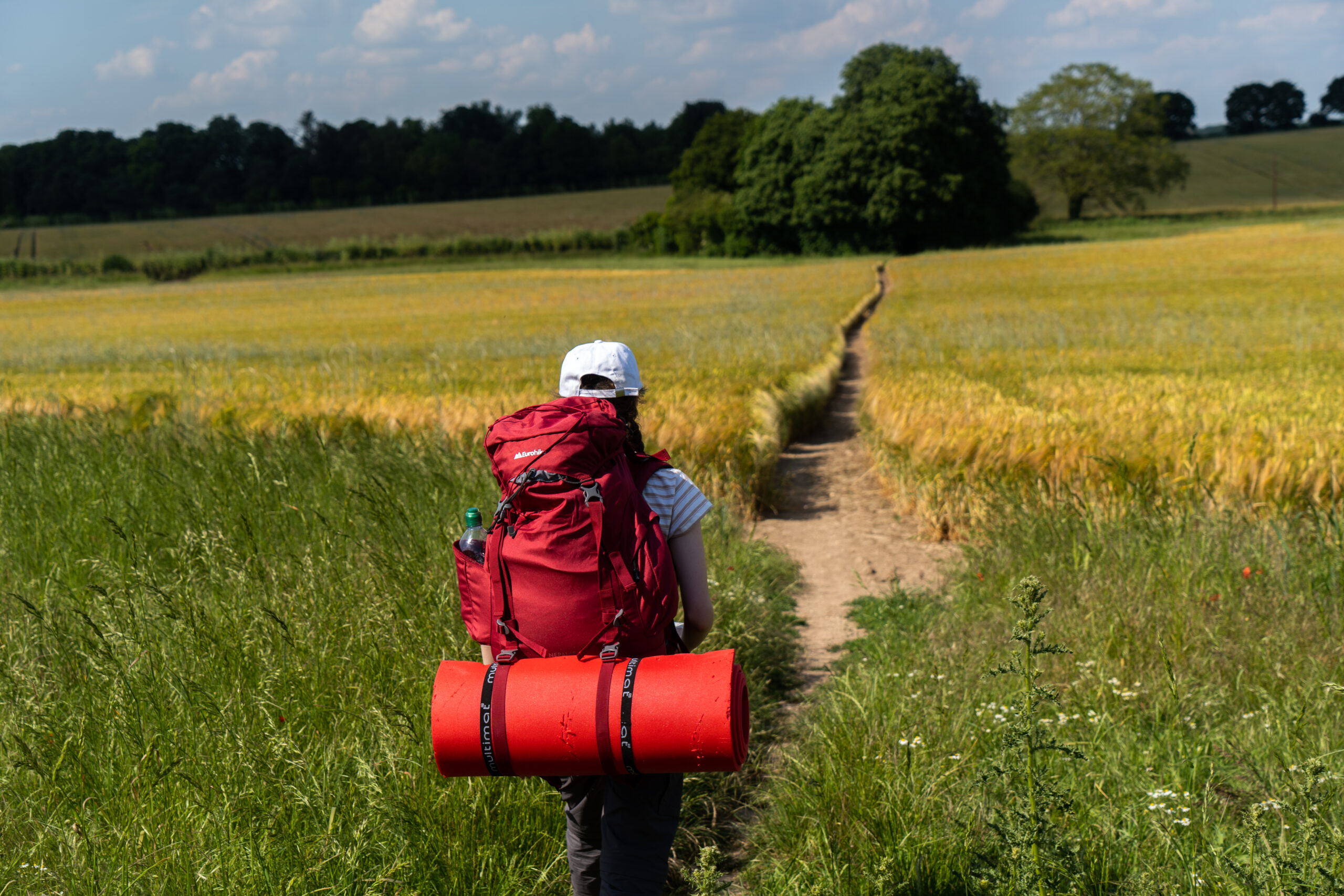
Learn to Pack your DofE Bag – Ruthless Packing Principles
In this post, School of Outdoors Expedition Leader Josiah Skeats talks through the best way to pack your rucksack — what to include and what to leave behind.
Where to begin...
Packing your Duke of Edinburgh bag can be stressful. There seem to be so many different things you need for an expedition – things you simply can’t live without – that it can feel impossible to squeeze it all into a single bag.
Yet, few things make an expedition more miserable than a bag that’s too heavy. Several days trudging across fields and hills with a bag that feels like an anchor is a great reminder of how little stuff you need. Many DofE participants learn this the hard way, packing way too much for their practice expedition and then much less for their qualifying expedition.
This blog should prepare you for what to bring, what to leave at home, and how to pack like a pro. Ignore this advice at your peril!
Choosing the right backpack for a Duke of Edinburgh expedition
Not all backpacks are equal; some are much more comfortable than others. Most good outdoor shops will allow you to put something heavy into a bag and try it on, try on a few to get a feel for what works best for you. A 60 litre backpack should be big enough for a bronze Duke of Edinburgh expedition, while you may expand to a 70 litre backpack for a gold expedition to accommodate the extra food and equipment such as a toilet shovel and water pump.
Be sure to check the backpack has a padded waist strap and a chest straps; you can adjust these to fit your bag more comfortably. Don’t hesitate to ask an instructor on your practice or qualifying expeditions to help fit these better. Some backpacks brand themselves as female specific or ‘short back system’ which are more appropriate for women and those who are shorter.
Buying a new backpack can be expensive. Be sure to ask your school if they have any spares you can borrow, check for second-hand bags on eBay, and always ask to use your DofE discount at outdoor shops.
Ruthless Packing Principles
You don’t know exactly where you are, but probably you’ve got a good idea roughly where you are. This is easier if you’ve been thumbing the map. How long was it since you last knew where you were? Even if you’ve walked a full hour, that still means you’re only around 3 kilometres from your last known point and can narrow your search to a 6 grid by 6 grid area. That’s already far less intimidating than scanning an entire map as it catches the wind like a kite.
With your search area narrowed, start looking for clues around you. Are you in a woodland or fields? Can you hear a road? Is there a footpath sign? Can you see a church? – often the highest building in a village – or a pub? – almost every village has one. Is the footpath heading north-south or east-west? These clues can slash the search area smaller and often help you discover your location altogether.
Strangest things spotted on expedition:
Deflated rugby ball and pump
Dustpan and brush
Maths textbooks
Wind up radio
Hair Straighteners
A home-made oven – a tin-foil lined cardboard box.
Lightsaber
Is There a Catching Feature?
I’m not going to tell you what to bring. You can find the Duke of Edinburgh packing list here. Instead, I’m going to teach you some ruthless packing principles so you can decide whether or not you need it.
Ensure your backpack never weighs more than a quarter of your bodyweight – for example, if you weigh 60kg, your bag shouldn’t be more than 15kg.
Your task is to balance the comfort of having the item versus the discomfort of carrying it. Generally, if something isn’t necessary, I’m sorry, but leave it out. Some exceptions would be a deck of a playing cards or a pair of sliders. Both are lightweight and can make your expedition more fun or comfortable.
I often ask DofE teams to put their hands up if they’ve packed suncream, toothpaste, a lighter, deodorant, a hairbrush, a first aid kit, etc. I’m often greeted with seven raised hands. What can you share amongst your team? To prepare this blog, I spoke with Katie and Niamh, two students who’d recently finished their gold expedition, and they echoed how important it was to share gear among your team. Particularly as they’d progressed onto gold, it had been necessary to work as a team to carry everything that was required. Writing this, I can already imagine you shaking your head and thinking they’re all only lightweight and you’d rather carry your own. But, it all adds up, and the more you can cut out the better.
DofE expeditions are quite short. Katie and Niamh laughed at how much they’d dreaded not having showers or make-up, but how easy it had been to survive without them. ‘After all, everyone is in the same position,’ they said, ‘but make sure you at least bring some wet wipes!’
Don’t fill your backpack. It’s always tempting to fill the empty space in your backpack but remember when you arrive at the start of your expedition, you’ll receive tents, stoves and a first aid kit that all need to fit inside.
Bring lightweight food for your expedition. Ingredients packed in glass jars or soaked in liquids are heavy and should be avoided. Dehydrated foods such as rice, pasta, or milk powder are lightweight and easy to carry.
Check out this blog [A DofE Menu to Look Forward To] to plan a menu that is lightweight and nutritious.
‘Lightweight’ is often used to market outdoor gear, but you generally pay lots more to shave off a few grams. If you have some extra money to spend on gear, a great investment can be an inflatable mattress which packs much smaller and lighter than its foam roll mat rival. Not to mention a more comfortable night’s sleep!
Top Tip: I’ll whisper this: Be careful letting your parents help pack your bag… unless your Dad is Bear Grylls. They haven’t done DofE, or at least not for many years, so although they want to help, when they see empty space in your bag, they’ll want to fill it with more food and another warm layer of clothes.
How to Pack your Backpack
As well as what you bring, how you pack can drastically affect your expedition. You should be able to get everything inside your backpack (with the possible exception of a foam roll mat waterproofed in a black bin bag). Things hanging from the outside can get damaged, lost, wet, or just dangle and be really irritating.
Pack your bag in the right order with the things you need quickly or often near the top. That means burying your sleeping bag, roll mat, stove, and tent deep into the bottom of the bag, but keeping your lunch, snacks, first aid kit, and waterproofs accessible near the top.
Waterproof everything. It rains in Britain. A lot. Even in summer, even when it’s forecast to be sunny, rain can add an extra challenge. It’s best not to rely solely on the backpack’s waterproof cover; also waterproof everything inside. Fancy dry bags are great but can be expensive, a cheaper idea is to keep your things in plastic carrier bags or bin bags. Remember to bring a spare in case the clothes you’re wearing get wet too!
Pack the bag so the weight is evenly distributed between the two sides. For example, keeping all your water on one side will make your bag wonky and uncomfortable to carry.
Top Tip: When you get home from your practice expedition, empty everything out your bag. If you haven’t used it, you probably don’t need to bring it next time. The exception to this is your waterproofs and first aid kit: hopefully you don’t need them, but you want them there just in case!