
How to Stop Getting Lost – and What to Do When You Are
In this piece, School of Outdoors Expedition Leader Josiah Skeats talks through the most reliable tools and techniques you can use to stay on course and avoid getting lost on your expeditions.
Where to begin...
This blog post isn’t the place to learn about grid references, bearings or the three different OS map symbols for a church. Such practical navigation skills are best learned on your practice expedition with your boots on a muddy footpath and a heavy bag strapped to your back. A practice expedition, walking initially with an instructor, is enough to transform someone who’s never touched a map into an expert.
Instead, this post tackles one of the most common concerns about Duke of Edinburgh expeditions: what to do when you get lost?
Read that sentence again: when you get lost, not if. Because let me whisper a comforting secret: DofE isn’t a navigation test, and getting lost doesn’t mean you’ve failed. Every team gets lost at some stage. Wow, even I, a Mountain Leader and DofE instructor, still get lost sometimes. I worked on this blog with Katie and Niamh, two students who’d just completed their gold expedition. When I asked if they’d got lost they erupted into laughed and began reflecting on ‘walking off the map’ on their bronze expedition because of a twisted signpost and stumbling into a bog while trying to find a campsite on their gold. These experiences, though intense and stressful at the time, had clearly become exhilarating memories.
So, if it’s not a navigation test and we expect you to get lost occasionally, what’s your assessor actually looking for? Like always in DofE, the answer is teamwork and independence. How does your team work together to solve the various navigation challenges?
How to Not Get Lost
Magical Maps
I like to think maps are magical; like a fortune-teller gazing into a crystal ball, I can glance at a map and predict precisely what happens. As I walk these predictions always come true, and if they don’t it’s normally means I’ve taken a wrong turn, not that the map’s magic has worn off.
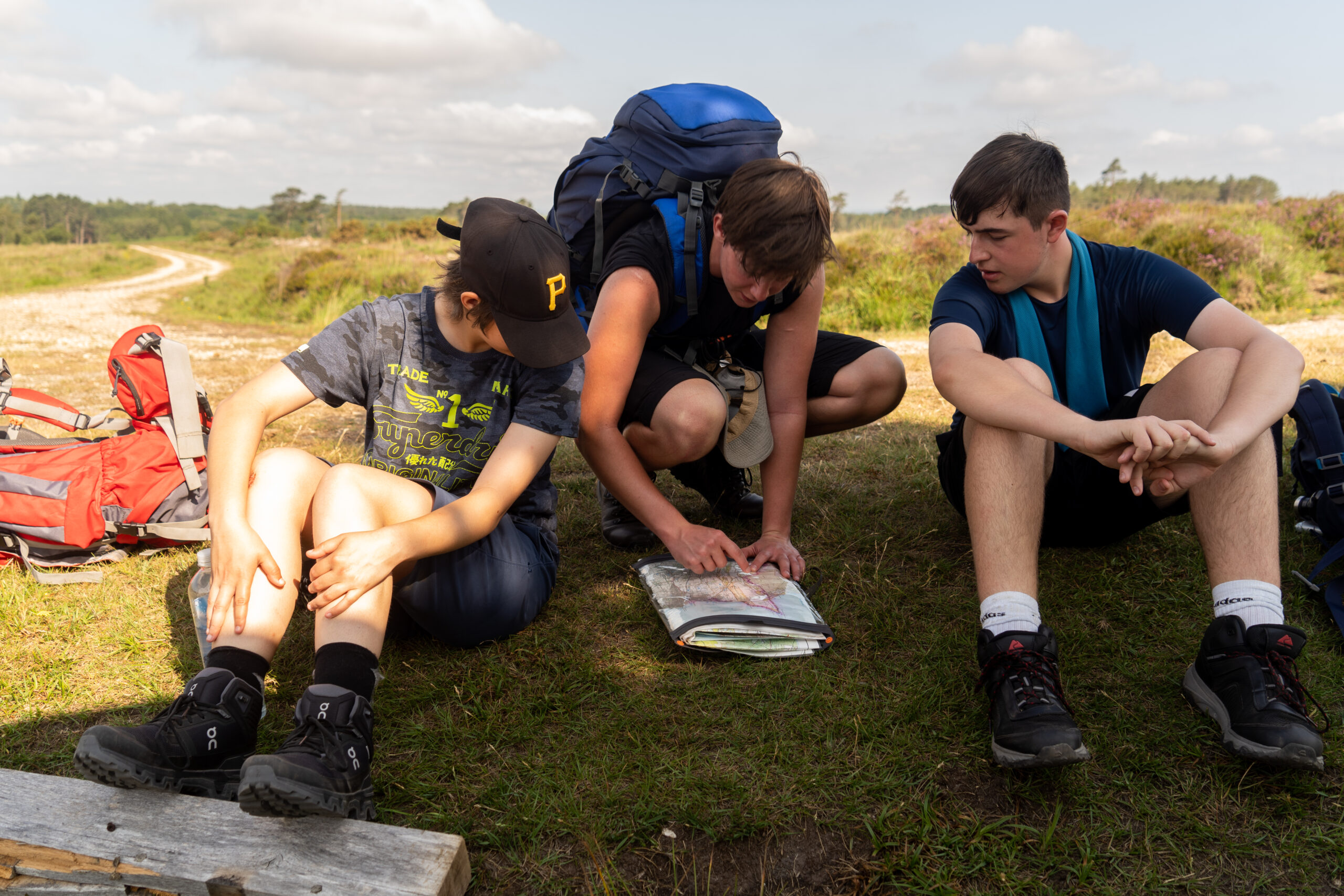
Your team only has two (magic) maps and compasses, but up to seven pairs of eyes. Usually in each team some people will be more confident to navigate and others less confident, but everyone plays a part.
Before you start walking, it’s a good idea to look at the map together and discuss what you’re expecting to see on the next section of the journey. What are your predictions? You might be entering woodland, passing a school, going uphill, or ignoring a footpath on the right. Be as accurate as possible. You can even measure the distance or time you’re expecting to reach each of these points, for example, ‘We’re expecting to cross a road in 500 metres so that will take about 10 minutes.’
Top Tip: At first navigation feels like hard and time-consuming work, but 30 seconds checking the map and compass can save an hour walking in the wrong direction. As you gain experience, reading the map and compass becomes effortless and instinctual.
Thumbing the map
With predictions made, everyone should stay observant, watching out for the features you’re expecting to see. As you pass each feature, make sure the other team members have also seen it, and that they agree you’re in the right place.
Whoever holds the map should hold it with their thumb at the team’s last known point. As each of your team’s predictions come true – as you pass the ‘tick-off features’ – the map-holder can slide their thumb along to where you are now. This means if you get lost, at least you know where you were last.
Whoops, you’re lost! What next?
Staying Calm
I’ll admit, staying calm when you’re lost is hard, but now’s a great time to drop your bags, sip some water, and check the map. Don’t panic and take a path because it’s there, don’t follow a dog-walker hoping they’re going the same way, and definitely don’t follow another DofE group – they may be just as lost!
Take comfort that School of Outdoors use trackers, so even if you haven’t seen your instructor for hours, they know where you are, are nearby and ready to put you back on track if you get seriously lost – though they’ll normally give you a chance to correct your mistake first!
Narrow Down the Search
You don’t know exactly where you are, but probably you’ve got a good idea roughly where you are. This is easier if you’ve been thumbing the map. How long was it since you last knew where you were? Even if you’ve walked a full hour, that still means you’re only around 3 kilometres from your last known point and can narrow your search to a 6 grid by 6 grid area. That’s already far less intimidating than scanning an entire map as it catches the wind like a kite.
With your search area narrowed, start looking for clues around you. Are you in a woodland or fields? Can you hear a road? Is there a footpath sign? Can you see a church? – often the highest building in a village – or a pub? – almost every village has one. Is the footpath heading north-south or east-west? These clues can slash the search area smaller and often help you discover your location altogether.
Is There a Catching Feature?
If you’re narrowed the search area and scanned for clues but still don’t know where you are, maybe a big feature can help find where you are. Perhaps heading east will bring you to a river and allow you to relocate yourself. Or maybe you can see a church in the nearby village, from where you can get back on track.
Retrace Your Steps
Consider retracing your steps if you can remember the way back without getting more lost. Groups are often reluctant to go back because it means adding more distance, but sometimes it’s the best option and things may be clearer the second time around.