
The Trinity of Expedition Food
In this post, School of Outdoors Expedition Leader Josiah Skeats explains why choosing nutritious food matters — and how it helps keep you fuelled after a long day’s walking.
Where to begin...
Eggs are a great source of protein, but I don’t want them splattered inside my bag after a day hiking, thanks. Steak is tasty, but the only recipe for raw meat on a summer’s day is a recipe for disaster. Crisps are a nice snack, but you’ll soon be carrying a bag half-air, half-crumbs. Unlike at home, eating nutritious food is only one consideration when on a DofE expedition.
The Holy Trinity
There are three important considerations when planning an expedition menu:
Nutrition – Is the food high in energy? Is it a good source of fats, proteins, carbohydrates, or sugars?
Compact – Will it fit in my backpack without taking up too much space?
Survivability – Will it survive in my bag until I’m ready to eat it?
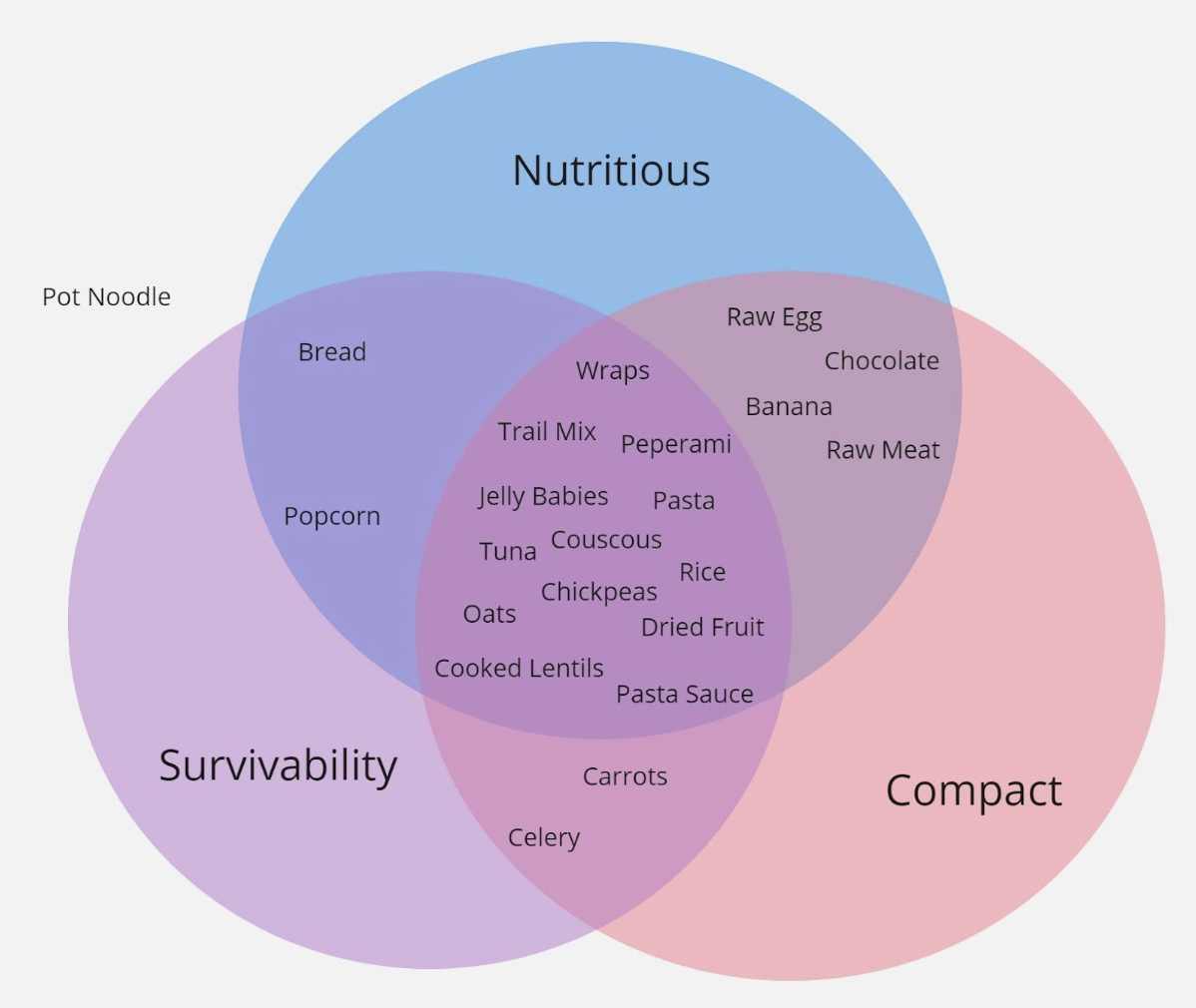
Try to imagine these as a Venn diagram. Ideally, we want food that satisfies all three at the same time.
(Some other considerations are weight (avoid glass jars and foods soaked in liquid), things that take a long time to cook, things that make a mess of the frying pan and are hard to clean, and things that are really expensive.)
A Few Words About Nutrition
Remember you’re going to need to eat more on expedition than you usually would at home. Plan on around 3,000-3,500 calories or just under double what you’d eat on a normal day.
All the nutrients help us on an expedition. For a balanced diet you want:
Carbohydrates because they give a long-lasting energy.
- Proteins because they help your muscles recover and are essential to stop you waking up with stiff legs and dreading walking.
- Fats because they contain a lot of energy.
- Sugars because a quick sugary burst might be just what you need to get up the hill or push on for the last part into camp.
Some good sources of carbohydrates are oats, pasta, rice, couscous, wraps. Whole Grains are complex carbs and will keep you fuller for longer.
Some good sources of protein are eggs, lentils, beans, tuna, peperami, biltong, nuts.
Some good sources of fats are cheese, olives, Nutella, nuts, and milk powder.
Some good sources of sugar are fruits (dried or fresh) and sweets.
The Trinity of Expedition Food – A Venn Diagram
Once you’ve planned your expedition menu, you might like to draw your own Venn diagram to check whether most of your ingredients would be in the middle box that satisfies all three considerations.
You can check our Duke of Edinburgh menu suggestions here for tasty meals suggestions that are nutritious, survivable and compact (and also cheap, lightweight, easy to cook and easy to clean!).